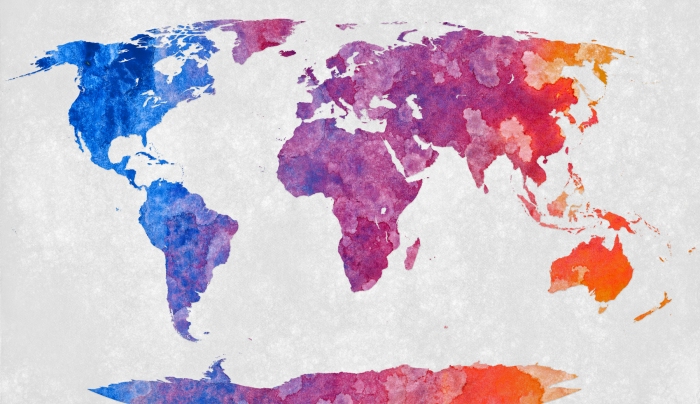
The future of Globalisation: To infinity and beyond


Close your eyes. I’m going to take you on a journey and our destination is only a few sentences away. Imagine you are lying on a beach. You are currently on the earth’s surface. We start to travel at the speed of light; it takes a second to reach the clouds. From here, it will take 90 seconds to reach the sun. The next closest star will still take us four light years to travel to, but I will take you further still. Our destination is the closest galaxy, Canis Major Dwarf Galaxy, which we will enter in two million years time.

Back on the beach, you open your eyes. Night has fallen, and not a single cloud lies between you and the stars in the night sky.

galaxies.jpg
“Each dot is a entire galaxy, containing billions of stars.” Source: Beyond our Sight

Try to find a spot, anywhere that is empty, all black. Draw a square. Because of our limited capabilities this area will remain dark for your eyes, despite the fact that billions of galaxies occupy that space. And in each of theses galaxies lie billions of stars, visible only for those who have found ways of perceiving infrared light.

What will result of a world that is increasingly interconnected? What does the future of globalization hold? An article on globalization states that there are three different scenarios for the future of globalization.


Scenario one: The end of globalization
3D-printers, robots and technology will reduce import demands. Agreements as NAFTA and WTO will lose respect and power and border controls within Europe will strengthen. All of these factors contribute to an anti-globalization wave, which would lead to a more isolated society, resulting in an end in globalization.

Scenario two: Two steps forward one step backwards
Similar to the first scenario, this one results in a reduction of trade markets between countries and a strengthening of international boundaries. At the same time technology will develop faster than ever which gives globalization fuel to grow. These factors in combination with each other make areas of globalization accelerate, and others slow down.

Scenario three: Accelerated globalization
Younger generations could push for a more interconnected world, or globalization be driven by growing economies that are aiming for new markets. If globalization continues to increase at its current rate, we could see the development of globalisation reach new heights.

Whether or not globalization accelerates or slows down, it is no longer bound to the earth, or even to our moon. Currently, there are humans living in space. The international space station (ISS) – is manned, every day, every minute and every second of the year. Soon globalization won’t even be bound to the ISS. In the 2030s humankind will colonize Mars. But the fact is, globalization isn’t even bound to Mars anymore. In August 2012, Voyager 1 reached interstellar space after traveling through the universe for 39 years, making it the first manmade craft to ever leave our solar system. Even if there are those who think globalization is slowing down, I don’t think we have a say in the matter anymore, for every meter Voyager 1 travels further in to interstellar space, the further our knowledge expands. Knowledge that challenges our borders, trade markets or minds, knowledge we share with each other. All these factors are important elements of globalization.

Something huge awaits, and who knows, maybe we are not the only ones who are exploring the universe, maybe we are crossing borders as we speak. Or maybe this is the beginning of the end for globalization, in which case we belong to something new: an era of curiosity.

Calling all members of Generation Y- What do you think the future of globalization holds?

“A mind that is stretched by a new experience can never go back to it’s old dimensions”

Oliver Wendall Holmes Jr. 


Can we disconnect from globalization?

I woke up to the sound of someone whistling, right outside my window. I froze. I didn’t even dare to breathe. The melody was so clear, so sweet and so close. After a few seconds, I quietly rolled over, reaching for my phone, and the lit up screen told me it was 04:30am and that I had a message from my mum. That message made me realize two things. Firstly, I had forgotten to tell her that I had arrived safely at my destination. And secondly, I was in Australia, my new home. This made me realise a third thing; there wasn’t anyone whistling outside my window; it was birds singing.

On my very first morning in Australia, I couldn’t bear to plug my earphones in and listen to music like I usually would on my morning powerwalks. I was afraid that if I shut the beautiful melodies of all the different birds off, they would stop singing. I was lost in time and disconnected from the world. When was the last time you experienced something like that? Before that morning, I can’t remember the last time I was offline.

Globalization isn’t only about traveling. It has become something much bigger than that. According to an article about globalization financial and economic are trade markets between continents; something that keeps development in line with globalization itself. But Stephen Brown claims that globalization also has become a trade market for communication, experiences, knowledge and information. In fact Brown indicates that social media is not only a platform for advertising and promotion, but has also created possibilities for communication integration across international boundaries.

It was never a matter of if globalization was going to take place, but when it would. Since globalization started it has and continues to accelerate. An article claims that human knowledge before year 1900 was doubling every century. Currently we double human knowledge every 13 months, clinical knowledge doubles every 18 months and knowledge about nanotechnology every second year. Some may find it scary that something that has been accelerating for so long still speeds up. I find it inspirational.

Information comes in every form. Whether it’s financial or artistic, from Brazil or Sweden, from social media or a book. We are in a time where it doesn’t take flying to China to buy their clothes; even if you have never been to Mexico you have tasted their food. Information is pumping into us. It’s everywhere, all the time, trying to make us remember. Researchers claims that human brain is exposed to information that corresponds 34 gigabytes of data, everyday. That means the human brain is exposed to 23 words every second; which is 105, 000 words every 12 hours you are awake. And on this page lies yet another 500 words that are filtering into your brain right now. But, if you going to remember anything from me remember this; We are now entering globalization 3.0 so take time to disconnect to the real world, because when you are connected again globalisation is changing gear, and it doesn’t slow down.

How do you disconnect the world, or do you even go offline? Please share your thoughts with me.

8384110298_b0bc7d6435_o.jpg

The human brain is truly amazing. Source: A Health Blog, 2012

To plant a seed

He looked at me with the glaze in his eyes and whispered, “You need to get out of this town”. His eyes were as hungry and eager as mine when he told me about his first journey overseas. There are people who have the ability to talk, there are people who have the ability to listen and then there are people who have the ability to plant seeds. He was planting seeds.

Researcher, Anders Johnson, claims that globalization took its beginning in 1846 with something called the first wave. According to those articles, globalization has transformed over three waves from 1846 onward, to the present day. In order to understand where globalization is taking us, we should try to understand where it came from. This blogpost said it all started in the mid 1800s…

The first wave:
When the first wave started, Great Britain was the heart of the world’s economy. Steam technology, electronics and internal combustion engines were developed, resulting in a boom in production rates and a reduction in transport costs, which in turn made it easier to travel to areas that were not accessible before.

The second wave:
The production of technology accelerated during the second wave, and jet plans, televisions and communication satellites were developed. From here, the trade markets opened up as a result of World War II ending. The boundaries between countries had begun to loosen up.

The third wave:
The speed of development in technology increased even more when microprocessors, computers, mobile phones and Internet became the main focus point of globalization. Because of this, we quite literally have the world at our fingertips, and we have the means to travel to any corner of the globe.

Other articles claim that Christopher Columbus was the contributing factor for globalization when he discovered America. It is said that his traveling around the world was the first sign of human globalization.

Articles may claim that it was the wave of technology, or one man that started globalization. I disagree. For me, globalization began long before the first electronics were made. Even before Columbus, stepped foot on the Santa Maria. I believe it started with the first man. It was in him before life was breathed into him. It ran in his veins, just as it runs in yours. Since the beginning of time, man has wandered the globe, searching for his own kind. Technology has just made it easier for us. I think that globalization starts somewhere inside all of us. It starts the moment you open your eyes in the morning, the moment you greet a stranger on the train, the moment you post your dreams on social media and the moment you decide to travel. Or it can start the moment you look into your grandfather’s hungry and eager eyes, listening to tales of his own travels overseas. The moment he tells you to get out of this one-horse town, and start living.

We all have a seed inside of us, the question is; are you going to let yours grow? Or what do you think?

10012162166_6e611105c5_o.jpg
Thanks to globalization, we can access the world. Source: Nicolas Raymond, 2013